
Daily Habits
The Morning Routine as a Personal Standard
A considered look at how structured morning habits shape the rhythm of a man's day — from the first hour of waking to the point of productive engagement.

There is a particular kind of exhaustion that arrives midweek, when every decision feels like it costs more than it should. Meal preparation — the deliberate act of spending two or three hours on a Sunday arranging the week's food — is not a wellness trend but a response to this exhaustion. It removes a category of daily decisions and replaces it with a single, considered act performed once.
The most consistent finding in the nutritional habits of men who eat well across a working week is not that they have superior willpower or unusual discipline. It is that they have reduced the number of food decisions required of them at peak-fatigue moments. The man who arrives home at 19:30 after a demanding day and finds a prepared meal waiting is making a single decision: to eat. The man who arrives home to an empty kitchen is making a sequence of decisions — what to eat, whether to cook, how long it will take, whether to order instead — each of which is marginally more difficult than the last.
This is the practical case for meal preparation, and it is more durable than the nutritional one. A man who consistently eats adequately prepared food will, over months, achieve better nutritional outcomes than one who intends to eat well but defaults to convenience food at high-fatigue moments. Intention without infrastructure is a plan that works only when conditions are favourable.
For men engaged in regular physical activity — whether gym-based strength work, outdoor movement, or a combination — protein intake is the nutritional variable that warrants the most deliberate attention. The body's capacity to support muscle protein synthesis is directly related to the availability of amino acids across the day, and this availability depends on consistent, distributed intake rather than a single large serving in the evening.
A practical target for most active men is in the range of 1.6–2.2 grams of protein per kilogram of body weight per day, distributed across three or four eating occasions. For a man weighing 82 kilograms, this means roughly 130–180 grams of protein daily — an amount that requires specific planning to achieve from whole foods without resorting to protein supplements as the primary source.
Meal preparation simplifies this considerably. A batch of cooked chicken breast, hard-boiled eggs, a container of Greek yoghurt, a prepared lentil dish, and grilled salmon filets represent five distinct protein sources that can be combined differently across the week without repetition fatigue. The Sunday investment of preparation time makes the daily assembly of a protein-rich plate take minutes rather than the thirty-plus minutes of active cooking that discourages many men from the effort.
"Meal preparation is not a diet strategy. It is an infrastructure decision — the difference between a week of considered eating and a week of managed emergency."
The balanced plate framework is, in its simplest form, a guide to proportions rather than quantities: half the plate composed of vegetables and salad, a quarter of lean protein, a quarter of whole-food carbohydrate. This framework is not a rigid formula but a practical default — a way of assembling a meal without calculation that tends, over time, to produce adequate macronutrient distribution and micronutrient variety.
The carbohydrate quarter is worth some attention. For men in physical training, carbohydrate availability supports performance and recovery in ways that become noticeable when intake drops below adequate levels. Whole-food sources — rice, quinoa, sweet potato, oats, legumes — provide this alongside fibre and micronutrients that refined sources do not. In a meal-prep context, a large batch of cooked grain or roasted sweet potato prepared on Sunday provides a ready carbohydrate component for four or five days of lunches or dinners.
The vegetable half is the component most men under-fill. The variety of preparation methods available — roasted, raw, steamed, wilted with olive oil — means that a weekly preparation session can include three or four different vegetable preparations without any one dominating. Variety matters nutritionally and, more practically, for the avoidance of the sensory fatigue that makes a meal-prep routine feel like a constraint rather than a resource.
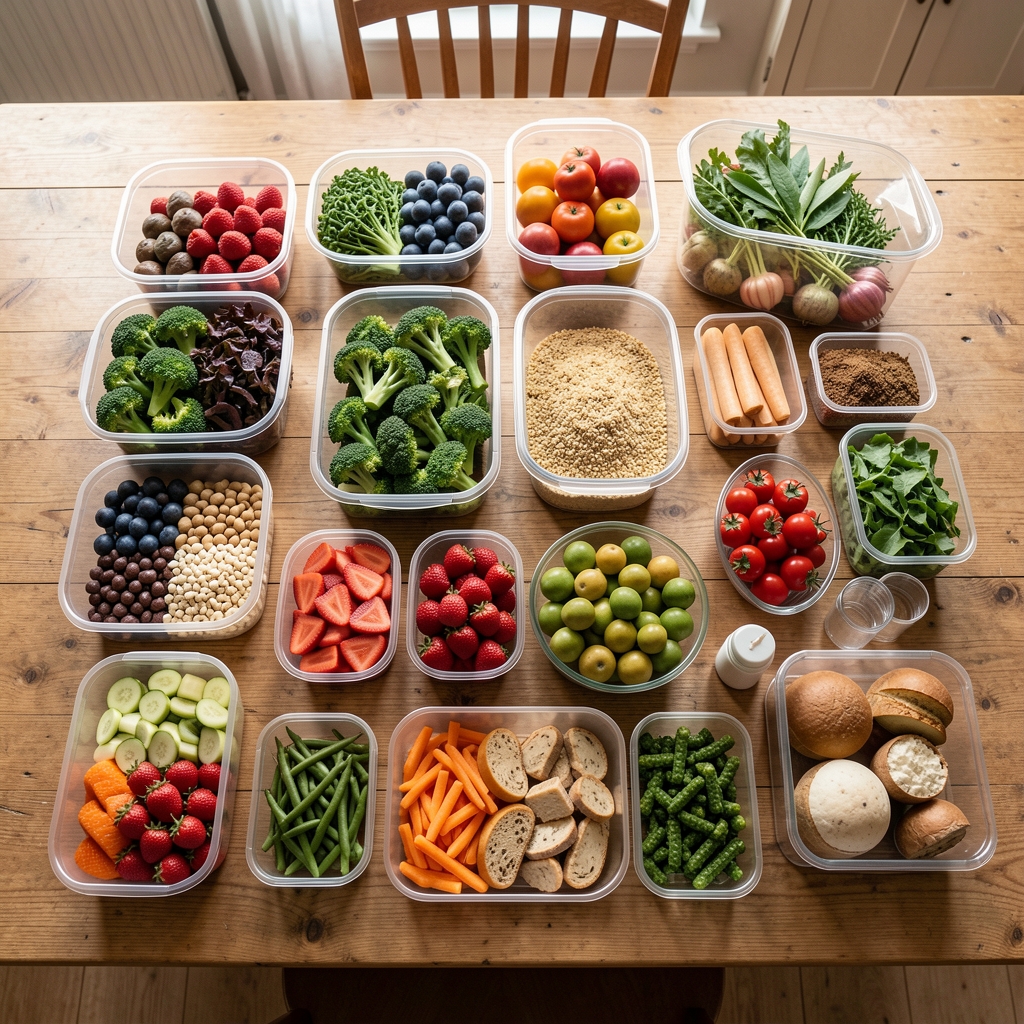
The Sunday preparation session works most efficiently when approached with a loose sequence rather than a strict recipe list. The following is one such sequence, requiring approximately two to two-and-a-half hours of active time:
Begin with the oven — the largest surface area and most hands-off cooking method. While the oven is preheating, prepare two or three vegetable components for roasting: root vegetables, brassicas, or alliums according to preference and season. Once these are in the oven, move to the stovetop: a grain, a legume dish, and a protein preparation (chicken, fish, or a plant-based alternative) can be managed simultaneously across three burners. A final cold preparation — a large salad base without dressing, hard-boiled eggs, a yoghurt-based component — can be assembled while the hot preparations finish.
The storage logic matters as much as the cooking. Components stored separately allow assembly variety across the week — the same chicken can appear in a grain bowl on Monday, alongside roasted vegetables on Wednesday, and in a wrap on Friday. This preserves the sense of variety that makes the routine sustainable. Pre-assembled complete meals, while convenient, tend to produce a monotony that erodes commitment within a fortnight.
The nutritional literature on hydration is straightforward and consistent: adequate fluid intake supports cognitive function, physical performance, and appetite regulation. The challenge for most working men is not awareness of this fact but the absence of a structure that makes adequate intake automatic rather than intentional.
A practical approach is to anchor hydration to existing habits: a glass of water immediately on waking, a 500ml bottle kept on the desk and refilled twice across the working day, water with every meal. This structure requires no tracking and produces adequate intake for most men without conscious effort. The meal-prep session on Sunday is a useful moment to fill and refrigerate a dedicated water bottle for the week — a small act that removes a daily friction point.

Eleanor Ashcroft writes on nutrition, whole-food preparation, and the intersection of eating habits with daily performance. She contributes periodically to Marleno Journal as a guest writer.
Related reading →
A considered look at how structured morning habits shape the rhythm of a man's day — from the first hour of waking to the point of productive engagement.

A practical account of building a consistent outdoor movement practice in an urban environment, with particular attention to the seasonal adjustments that sustain it year-round.